 |
| Add caption |
Thursday, November 01, 2012
Only a Few Days Left!


Sunday, October 14, 2012
Thank You!

Even on a chilly October afternoon, chocolate melts in the sunshine! And contributions totaling more than $500 melted the hearts of the Logue Librarians, student leaders headed by Olivia Marcinka and Christopher Dunn, and Sister Regina's family.
 Last Thursday was cool enough for sweaters & jackets on the McCaffery Lounge patio, but even so, turnout at the first ice cream social honoring Sister Regina Maria Brimmer on her birthday was phenomenal!
The party's proceeds will benefit her namesake, the K-12 Brimmer Collection at Logue Library. Funds raised are being matched by the Alpha Lambda Delta Honors Society.
Thanks so much to all who attended and ate ice cream to celebrate Sister Regina's birthday and support her legacy in Logue Library!
Watch the slideshow below, or view the photo album here.
Watch the slideshow below, or view the photo album here.
Made with Slideshow Embed Tool
Wednesday, October 03, 2012
Presidential Debate Coverage
 |
| President Barack Obama and Republican presidential candidate, former Massachusetts Gov. Mitt Romney, right, campaign in swing states, Obama in Leesburg, Va., and Romney in Waukesha, Wis., in these Aug. 2012 file photos. (AP Photo) |
See also . . .
What you need to know about [moderator of tonight's debate] Jim Lehrer's rules - from the Christian Science Monitor
Commission on Presidential Debates - Transcripts and other information about past and future presidential debates, elections issues, candidate platforms and online voter education.
New Voter ID and Voter Registration Information

An update to our August 7th post
A judge ruled this week that Pennsylvania state officials cannot enforce a new
voter ID law for the upcoming Presidential election. Read full details on the judge’s decision here.
Even
with this ruling, there are still some important things you need to know:
In
order to vote in any election, you must first be a registered voter. In
PA, you must be registered before October 9, 2012 for this general election in
November. You have the right to register where you live now, whether that
is an on-campus address or off-campus location. Or you may choose to
register or remain registered and vote at your permanent home
address. Get information on registering in your home state here. Please note that each state sets its own deadlines!
In
Pennsylvania, you must be at least 18 years of age on November 6, 2012 and you
must vote in the County you are registered in!
A list of local polling locations is available here. Go to VotesPA.com for more information, or call 1-877-VOTESPA.
Absentee
Ballot:
If you
intend to vote by way of absentee ballot, you will need to be able to provide
either the last 4 digits of your SS#, or your driver’s license/PennDOT ID # as
proof of identification. Please contact your local County office
for additional information.
The
last day to apply for an absentee ballot is October 30, 2012. The last
day for County Elections to receive the absentee ballot is November 2,
2012.
FAQs
What
if I have a problem at my voting location?
Please
ask to speak with the Judge of Elections who is always on site.
What
is a provisional ballot?
A
provisional ballot is used to record a vote when there is some question regarding
a voter’s eligibility. You have a right to vote by provisional
ballot if:
1)
Even though you are properly registered and eligible to vote in the election
district/location, your name does not appear in the poll book and the election
officials cannot determine your registration status
2) An
Election Official asserts that you are not eligible to vote
How
do I know my provisional ballot is counted?
Within
seven days after the election, the County Board of Elections will examine your
provisional ballot to determine if it is valid. After this
seven-day period, you can find out if your provisional ballot was counted,
partially counted, or not counted by calling 1-877-VOTESPA.
The
Future of the Voter ID Law
While
you will not need an ID for the November Presidential Election, you may need an
ID for future elections. It is not too early to start planning
ahead. Please read the following if you would like to know more about
acceptable forms of ID in PA:
All Photo IDs must contain an expiration
date that is current, unless noted otherwise: A
Pennsylvania driver’s license currently valid or expired less than 12 months
- An ID issued by PennDOT currently valid or expired less than 12 months
- A currently valid U.S. Passport. Expired passports will not be accepted
- A currently valid CHC ID, issued by Chestnut Hill College containing a printed date on the front, bottom left, as the following example shows:

- A currently valid military dependent’s ID. Expired ID will not be accepted
- A currently valid active duty or retired I.S. military ID, including the PA National Guard
- A currently valid employee ID issued by the Federal, PA. State or PA County or PA municipal government
- A currently valid ID issued by a PA Care facility
If you
DO NOT have any of the accepted forms of Photo ID as stated above and you are a
currently enrolled Chestnut Hill College student, faculty or staff member, you
can obtain a new ID (as shown above) by visiting Security on the Ground Floor
of Fontbonne Hall. Please note that free IDs will be issued to
individuals who turn in their old ID. However, free IDs cannot be given
to anyone unable to surrender their old ID (this is for security purposes).
Please
do not wait until the last minute to prepare for this election!
You
may also obtain a FREE acceptable form of Photo ID at any PennDot Photo
Licensing Center. This ID will be valid for voting purposes only.
Information reprinted from the Chestnut Hill College office of the Dean of Student Life
Information reprinted from the Chestnut Hill College office of the Dean of Student Life
Wednesday, August 29, 2012
Sister Regina Maria Brimmer October 11, 1918 - August 11, 2012
Gentle woman, quiet light, morning star,
so strong and bright, gentle Mother,
peaceful dove, teach us wisdom; teach us love.*
 |
| Just before Lent. Sister Regina always gave up her favorite: ice cream! |
On Wednesday, August 9, in the company of many dear to her, Sister Regina lost consciousness as a result of a "cardiac event" and was taken to Chestnut Hill Hospital. After being surrounded by family & friends for two days, on Saturday, August 11, she died peacefully.
We remember Sister Regina as the engine that runs the library! Her energy, humor, and wonderful perspective kept all of us moving forward on an even keel. We miss her enormously, even as we still feel her presence here with us.
So many people have shared their memories of her with us. We would love to
hear yours! Leave a comment, or stop by any time.
Blessed are you among women,*From lyrics by Carey Landry and North American Liturgy Resources, "Hail Mary, Gentle Woman." ©1978
Blest in turn all women, too.
Blessed they with peaceful spirits.
Blessed they with gentle hearts.*
Tuesday, August 07, 2012
PA Voter ID Law Leaves Some Students Out
 |
| Click the image to view a larger version |
November's election is shaping up to be a complicated affair in Pennsylvania, and a few other states with Voter ID laws. Logue Library's election resources web page includes a continually updated news feed of the latest issues in the PA Voter ID Law. Students should be aware of the challenges they face in voting this year in Pennsylvania.
"You think your vote doesn't matter? Then why are they trying so hard to take it away from you?" asks Heather Smith, president of Rock the Vote, a group that works to register young voters. "It does demonstrate the power they have." - USA TodayUnder the PA Voter ID Law, a current photo ID with an expiration date is required to vote. Most student IDs in Pennsylvania do not have an expiration date, including Chestnut Hill College student IDs printed prior to the 2011-2012 academic year, and all IDs for students of the School of Continuing Studies. Some colleges & universities are adding an expiration date this year in response to the law; others are providing expiration stickers for ID cards that have already been printed. Chestnut Hill College is researching all of the options available, to choose the best one to meet the needs of our students.
Why is a college ID so important? Why not just use a drivers license? Students from out of state will need a Pennsylvania ID to vote in Pennsylvania.
It's not uncommon for out-of-state students to vote where they think their vote has the most impact. So if they attend a school in a swing state, they often vote there. It also can simply just be a matter of convenience, and a way to avoid going through the process of getting an absentee ballot. - US News & World ReportIt is important for students to decide where they want to vote, and then to take the steps needed to ensure that they are able to vote. It is your constitutional right, but as long as the voter ID law stands, it has become more complicated.
Friday, May 18, 2012
Once-or-Frequently Asked Questions
Ah-ha!! A recent question about our website let us know that at least one virtual user of the library wants to be able do more on-line.
I see how to find books, but what about putting them on hold? (Currently, holds cannot be placed this way; please contact a librarian!)
We are always looking for ways to make library research more efficient and intuitive, and the best way to know what is working and what isn't is to listen to you! The "Start" tabs on all of the library's web pages have a place for sending a little feedback. We'd like to reply to follow up, but sometimes the comment is left anonymously. As we look for ways to improve, we are adding a tab to the About page of our website. This FAQ tab will give us a space to post the questions we get with answers.

Any time you have a question we hope you'll ask! If the question comes via one of the Feedback boxes, check the FAQ tab in the next day or two to see if an answer has been posted.
Thanks for your feedback!
We are always looking for ways to make library research more efficient and intuitive, and the best way to know what is working and what isn't is to listen to you! The "Start" tabs on all of the library's web pages have a place for sending a little feedback. We'd like to reply to follow up, but sometimes the comment is left anonymously. As we look for ways to improve, we are adding a tab to the About page of our website. This FAQ tab will give us a space to post the questions we get with answers.

Any time you have a question we hope you'll ask! If the question comes via one of the Feedback boxes, check the FAQ tab in the next day or two to see if an answer has been posted.
Thanks for your feedback!
Friday, April 27, 2012
Google Scholar Interface Update
Earlier this month we posted about the ups and downs of using Google Scholar (among other Google search tools) for academic research. Today, the Google Scholar interface is up and running, making searching this way far more expedient than it used to be. Clicking the "full text" link to the right of a search result will open the article in EBSCOhost.
Set Google Scholar preferences on an off-campus device:
- Go to http://scholar.google.com/Click the link next to the search box called "scholar preferences"
- Scroll down to where it says "library links"
- Type chestnut hill college into the search box
- Check the box next to chestnut hill college when it appears below the search box
- Scroll to the bottom of the page and click "save preferences."
Wednesday, April 25, 2012
Big news on the drive to work today! The New York City Department of Records has released a gallery of over 800,000 images and audio from the Municipal Archives, including glass-plate crime-scene photos from the NYC Police Department. Free and open access makes this historic resource a great tool for researchers in many subject areas ... history, political science, art, criminal justice, sociology, and others.
The link the the Gallery went live today after being up quietly for two weeks. It contains digital artifacts from as far back as the mid-1800s. Links to the gallery can be found on the Web Resources pages of the Library's website. Let us know what you think!
 |
| In Oct. 7, 1914, painters are suspended from wires on the Brooklyn Bridge in New York. Photo provided by the New York City Municipal Archives |
Wednesday, April 04, 2012
Using Google for College Research?
It wasn't all that long ago that librarians and educators at the college level admonished students to give up the googling habit they acquired in their primary and secondary schools. So why are so many of us changing our tune now, in a time when there is more information on line than ever, from more sources than ever, creating an even greater need than ever to be able to separate the wheat from the chaff?
Well, because that is exactly what some of Google's tools have been working at, and in the process there has been a collaboration with library systems that makes searching more interactive with the student's library. And that's a good thing because, lets face it, no matter how much we beg students to leave Google for lighter fare, they're never going to do it. The goal, then, is to make using Google work well for academic research.
Until now we at Logue Library have adopted an "if you can't beat 'em join 'em" attitude," teaching the use of Google Scholar with the added step of how to copy information from the article citation, and plug it into our eJournals directory to see if the library subscribes to that particular issue of the journal that contains the desired article. It's clunkier than searching EBSCOhost, PsycNET or another of our subscription databases that already contains the full article content (or links to the full content) without being asked to pay $15-$35+ from the publisher.
This month, Logue Library is working with EBSCOhost to link its electronic subscriptions to Google Scholar search results. When the process is complete, students searching from locations on campus and using their ID from off campus will be a click or two closer to getting access to the content they find through Google Scholar. We will be asking for volunteers to help us test it in the next couple of weeks. If you would like to see a preview of this firsthand, volunteer!
Google Books (NOT Google Play Books)
Interaction between the Online Computer Library Center (OCLC) - the world's largest public access online library catalog - and Google Books (not to be confused with Google Play Books) has been quietly available since 2008 but is still a little bug-gy on the OCLC end. When searching from a computer or mobile device,* select a book from the Google Books results list and look in the left menu. There will be one or the other of two links for searching a library catalog. If the book is not available as an eBook, the link Find In A Library is visible after a list of purchase locations. If it is an eBook, first click the link Get This Book In Print, and then Find This Book In A Library, which is below a list of places selling the book.
That link will take you to the web version of the OCLC catalog WorldCat. Students logged into a computer on campus or through the proxy server will see a box below the book description stating that they are connected to the Chestnut Hill College network, and providing a link to the library's catalog. A link to OCLC First Search is next to the catalog link, and serves as a back-up if the library's catalog link is not configured properly or the library does not have the book or this particular edition of the book. Clicking the First Search link will also give students the opportunity to request a book through interlibrary loan, rather than make a purchase.
*Note from Diane: When you search Google Play Books, you will not see any links to library holdings. When you are on your iPhone or Android and you type books.google.com into the browser, the page that displays contains a button that says, "Get the Andriod App." That app is the Play Books app. There is no app that I am aware of for books.google.com. Ignore that button and search Google Books on your phone the same way you would on your laptop browser.
Yesterday, Google announced an extensive update to their Art Project, and we have added it as a resource to the Logue Library Arts Web Resources page. As of today it contains some 30,000 works from over 150 galleries worldwide, browsable and searchable by collections, artists and genres. Students and educators can create individual galleries to reference in research and presentations. It is interactive and allows students to not only collaborate with other students and professors, but contact experts directly.
Contact a Logue Librarian for help integrating Google into your academic research.
Tuesday, April 05, 2011
Help Wanted!
 Have you located an awesome resource during your research that you think future students might find useful as well?
We try to include resources on our subject web pages that will make your research dynamic and comprehensive, including RSS feeds of the latest news headlines and blog posts from reputable, citable resources in your subject, podcasts, and current tables of contents from leading journals, with links to the full text.
One thing I've noticed is that there is always more out there than we can possibly collect ourselves. There are only so many hours in a day!
MANY HANDS MAKE LIGHT WORK!
Your recommendations will help us put the best and newest research and information on our pages for other students to find quick access to. Pop into the "Ask A Librarian" chat window (even if we aren't on line at the time) or send an email to librarians@chc.edu.
And while you're at it, check out our Readers Corner page and give us a short review of your latest favorite book. We'll feature it on our site.
Thursday, September 09, 2010
Welcome Back!
As you begin your research using Logue Library's web page, please note that access to many of our resources are limited to the faculty, staff and currently enrolled students of Chestnut Hill College. If clicking a link presents you with a box like THIS:

Enter your CHC email username & password OR your library barcode number in the appropriate boxes. Come to the library's circulation desk to receive a barcode sticker for the back of your student ID.
We are here to help guide you through your research and welcome your questions. See any one of us, or type a question in the Meebo box for answers to quick questions. If you would like to spend a bit of time with one of us working on your research, ask to schedule an appointment, and we will sit with you for an entire hour if you need it.
We hope you have a very enjoyable & successful semester at Chestnut Hill College!
Tuesday, June 01, 2010
Tuesday, May 11, 2010
Award-Winning Teacher a Chestnut Hill College Graduate
The Philadelphia Inquirer recently featured this year's 66 Lindback Distinguished Teaching Prize winners in an article titled In city classrooms, teachers with class.
One teacher from each of the Philadelphia School District schools is honored. Chestnut Hill College alumna Claudia DiCrosta was among them.
Claudia DiCrosta
Swenson Arts and Technology High School
Claudia DiCrosta was born and raised in Portugal. She holds a bachelor's degree in Spanish from Chestnut Hill College, where she minored in secondary education and psychology. Her first teaching position was at William Penn High School. Moving to Swenson Arts and Technology High School in 2006, she demonstrated her commitment to its students from the first day. She also mentors Temple and La Salle University students who are prospective Spanish teachers.
See the entire list of Distinguished Teachers profiled.
Wednesday, May 05, 2010
Buyer Beware!


FRONTLINE last night delved into the for-profit college industry in their program, College Inc.
These billion-dollar businesses are cashing in on a boom in degree-seeking non-traditional students . . . those who are already established in the workforce and are looking to upgrade or change careers.
From unsavory sales practices to fraudulent degree programs, students have a lot of homework to do before deciding to go this route.
Friday, April 23, 2010
The REAL Reason We Have a Blog!
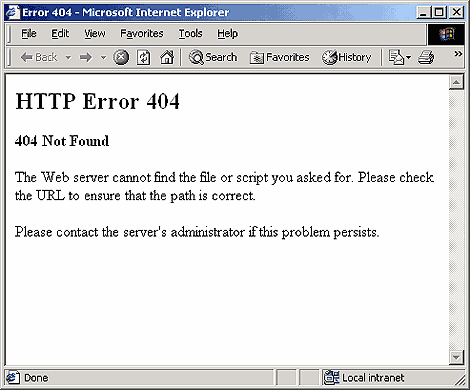
. . . if anything is going to go wrong, it will go wrong just when you need it the most . . .
Recently the Chestnut Hill College web site server has been experiencing the effects of Murphy's Law. That is to say, if anything is going to go wrong, it will go wrong just when you need it the most. As stress mounts among the student population at the end of the semester -- and academic year -- the more likely access to the resources students depend on to finish their work will fail.
We feel your pain. We live it, too. That is why we created this blog three and a half years ago. On the left side of the page we have listed links to the most used journal article resources we subscribe to, the library's catalog, and a link to an alternative to our Web Resources pages. We use the bookmarking website "Delicious" for that.
We feel your pain.
You can also IM a librarian in the chat box under the links.
Please don't forget that this is here as an alternative! And if you were looking for an easy "'dog ate my homework'-for-the-21st Century" excuse to not have your work done... well, sorry about that!
Tuesday, February 02, 2010
Student Research in the Spotlight... From Today's Philadelphia Inquirer
Today's paper contains an excellent example of the impact student research can and does have on society and politics. Imagine the implications of YOUR research as you delve into your Senior Seminar project!
-----Two debates over marriage
"Former President Harry Truman said yesterday he did not believe white persons should marry Negroes. He said that racial intermarriage ran counter to teachings of the Bible." - New York Times, Sept. 12, 1963By Grant Calder
Last year, an 11th-grade student of mine wrote a paper examining the controversy over interracial marriage from the mid-1950s to the mid-'70s. My student, Susannah Ivory, wanted to know more about the public debate surrounding Loving v. Virginia, the 1967 Supreme Court decision that unanimously struck down laws banning interracial marriage.
To keep the project manageable, Susannah restricted herself to one newspaper, the New York Times. She ran a search of its historical database for all of the items in which miscegenation or interracial marriage were mentioned during the two-decade period. Since the advent of digitized, online newspaper archives, data of this sort can be gathered in minutes; research opportunities are limited only by a student's ability to pose good questions.
A graph of the results showed two striking peaks: a big one in the mid-'60s, which was no surprise, and a completely unexpected bump in 1956 and '57. The articles revealed that the mid-'50s spike stemmed from the relaxation of censorship laws prohibiting the depiction of interracial relationships in books and films. For the first time, the public had an opportunity to experience and react to this type of integration - a decade before the Supreme Court got involved.
A typical 1958 article began, "A new novel by Legette Blythe titled Call Down the Storm is planned for publication next month by Holt. It is a story of miscegenation and racial integrations from the closing years of the Reconstruction period to the present."
Mentions of miscegenation disappeared almost completely from the Times by the end of the decade, but they resumed again in the early '60s as couples began to challenge the laws against interracial marriage in state courts. This time, higher-profile individuals and groups began to weigh in.
"Interracial marriage is completely compatible with the doctrine and canon law of Roman Catholicism, a national church organization said today," one 1963 article read. " 'Races do not marry,' the statement declared. 'Nations do not marry. Classes do not marry. Only persons marry.' " So much for President Truman's claims, two months earlier, of biblical prohibition.
In 1964, an article reported that a group of scientists working for the United Nations had issued a study stating "there is no biological justification for banning interracial marriages, nor for any advice aimed at banning them."
Susannah ended her paper with a reference to our own era: "The striking down of the anti-miscegenation laws represented a major step forward toward a more open and accepting society, but the time has come again for such a leap. Homosexual couples are now in the same situation that mixed-race couples were a half-century ago, and they face the same challenges."
In Loving, the court wrote, "Marriage is one of the 'basic civil rights of man.' ... To deny this fundamental freedom on so unsupportable a basis as the racial classifications embodied in these statutes ... is surely to deprive all of the state's citizens of liberty without due process of law." It doesn't seem like much of a stretch to suggest that these sentiments could apply to same-sex couples.
Today, the United Nations and the Catholic Church both find themselves involved in the debate over same-sex unions. Two years ago, on the 60th anniversary of the Universal Declaration of Human Rights, a headline read, "In Europe, same-sex showdown moves to U.N." The accompanying article noted that 27 European countries supported a new declaration decriminalizing homosexuality, but the Vatican was resisting it. The Bush administration refused to sign on to that declaration, but the Obama administration joined 70 or so countries in supporting it last year.
Not surprisingly, the most cogent arguments in favor of personal freedoms often come not from governments or organizations, but from the individuals fighting for them. From a 1972 article, Susannah quoted the black mayor of Tuskegee, Ala., who was married to a white woman.
"A lot of things went through our minds," he said. "We felt there might be actual physical danger. We thought about hurting our friends and relatives. We even thought about the effect it would have on my political career. Finally we came to the point and said, 'To hell with it. I love you, and you love me. We're going to do the only honest and right thing.' " Sometimes it's that simple.
Grant Calder teaches history at Friends' Central School. The full text of the paper is available at researchproject.friendscentral.org.
Wednesday, November 18, 2009
Oxford's Word of the Year - "Unfriend"
.jpg)
unfriend – verb – To remove someone as a ‘friend’ on a social networking site such as Facebook.
Every year at this time, Oxford University Press announces a list of "words to watch" for possible inclusion in the next edition of their dictionary. The word at the top of the list becomes their Word of the Year.
An explanation on the OUPblog site says, "Unfriend has real lex-appeal” because friend has not, until now, been considered a verb.
- Interestingly, the word unfriend is not used on the configuration pages of Facebook. The phrase "Remove Connection" directs the unfriending action.
Curious about other Words of the Year? The website AskOxford published a hundred Words of the Year. Here are the past 10 years of words:
1998 • to Google
1999 • blogger
2000 • bling
2001 • 9/11
2002 • metatarsal
2003 • to sex something up
2004 • chav
2005 • biosecurity
2006 • bovvered
2007 • locavore
2008 • hypermiling
Which of those had staying power?
- Becoming the Word of the Year does not guarantee inclusion in the dictionary. The verb to google did not enter the Oxford or Webster's dictionaries until summer of 2006.
Thursday, November 12, 2009
Should Everybody Go to College?
 Photo by Noah Berger for The Chronicle Review

In the most popular item posted this week on the website of the Chronicle of Higher Education, experts in economics, education, management, political science, and career counseling in the field of higher education are asked if they think everyone should go to college.
The responses are widely varied. In Are Too Many Students Going to College? the experts do not agree. This makes sense. The decision to go to college is personal and quite often a family decision. Deciding to continue education beyond high school is a financial and time commitment, whether the choice is community college, a two year or a four year degree program, or a shorter program designed for specific career preparation.
The issue seems to not be, "should you go," but "where should you go." Clearly in today's world, post-secondary school education gives people a better chance of a higher income. It is safe to say that what high school used to give you in earnings now requires some higher education.
Which expert do you agree with? Is college a waste of time and manpower, is it essential to earning a living wage and finding fulfilling employment, or something in between?
Tuesday, November 03, 2009
Shuttle Schedule from Logue Library Changes During SEPTA Strike
Early this morning SEPTA drivers went on strike; this strike impacts bus lines, trolley lines and the subway. Regional Rail (which runs the SEPTA R7 and R8 trains into Chestnut Hill) is not impacted by the strike but is currently running up to 30 minutes late due to increased volume.
In response to the strike, the College’s shuttle system will be running on a modified schedule.
- One shuttle will run a continuous loop between the R8 station, the R7 station and Logue Library.
- The second shuttle will run between Logue Library and SugarLoaf approximately every 15 minutes.
- Finally, a third shuttle will make as needed runs depending on traffic patterns and train schedules.
We ask for your patience during these times; there may be delays in the shuttle due to increased ridership and traffic. We will keep the College community informed of any updates.
For information on the SEPTA strike and help in planning a different route to campus please visit http://www.septa.org/.
Subscribe to:
Posts (Atom)